


Docomo versus SoftBank Prepaid for Japan
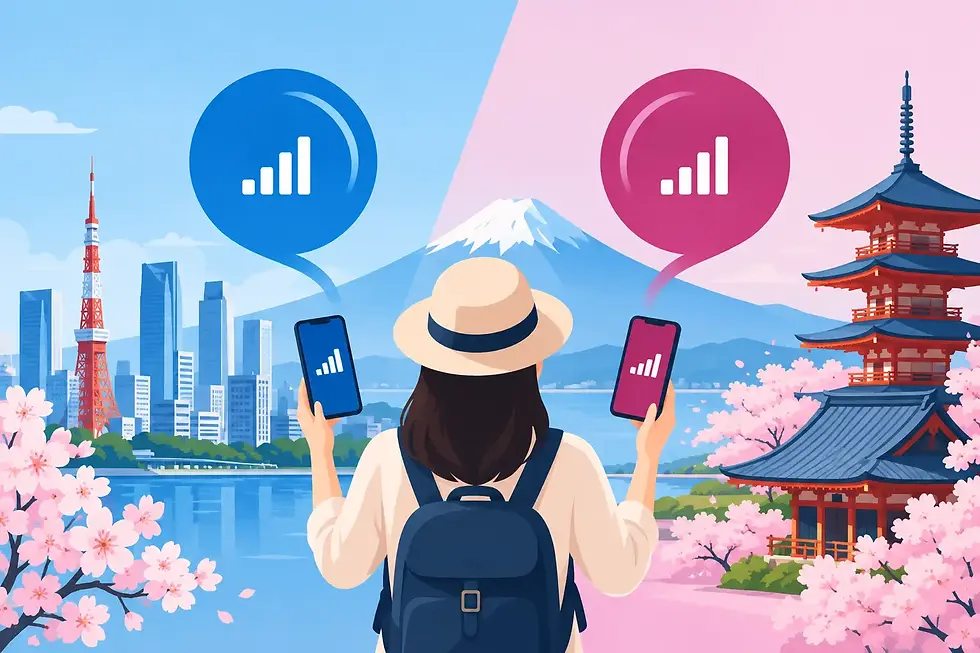
A missed train connection, a hotel address that will not load, or a work message waiting at the airport can turn mobile service into an urgent decision. When comparing Docomo versus SoftBank prepaid for Japan, the right choice is less about a universal winner and more about where you will travel, how much data you need, and how quickly you need to be online.
For visitors, returning residents, students, and business travelers, prepaid service avoids long contracts and surprise roaming charges. The key is choosing a plan that works reliably not only in central Tokyo or Osaka, but also on train routes, at your accommodation, and wherever your itinerary takes you.
Docomo versus SoftBank prepaid: the practical difference
Docomo and SoftBank operate large nationwide mobile networks in Japan. Prepaid SIM and eSIM services may use these carrier networks directly or through an MVNO, which is a provider that sells service using a carrier's network. That distinction matters because the product terms, data allowance, customer support, activation method, and speed policies can vary by provider even when the underlying network is the same.
Docomo-based prepaid service is often the first choice for travelers planning to visit several regions, spend time outside major cities, or rely on mobile data for work and navigation. Its network is widely recognized for broad geographic coverage, including many rural areas and transportation corridors. For a long trip that includes Hokkaido, mountain towns, regional business sites, or island travel, coverage reach can be more valuable than a small difference in price.
SoftBank-based prepaid service can be an excellent fit for stays concentrated in major urban areas. Tokyo, Yokohama, Nagoya, Osaka, Kyoto, Fukuoka, and other large cities are well served. It can also be a sensible option when a specific plan offers the data amount, duration, or device compatibility you need.
Neither network guarantees the same experience at every street corner. Building materials, underground locations, crowds, local terrain, and network congestion affect any mobile connection. The practical question is where you need dependable service most often.
Choose based on your itinerary, not a carrier logo
A short city break and a two-month work assignment create very different needs. Start with your travel pattern.
When Docomo-based prepaid is often the safer choice
Choose a Docomo-based plan when your route includes regional cities, rural destinations, long rail journeys, or frequent travel between prefectures. It is also a strong option for people who want one connection to cover sightseeing, maps, translation, ride-hailing, digital tickets, and work communications without repeatedly searching for Wi-Fi.
For corporate coordinators, broad coverage can reduce avoidable support requests. A visitor arriving for training, an employee traveling to a factory, or a research group moving between campuses needs service that is predictable beyond the downtown business district. A carrier network with wide reach is particularly useful when the itinerary may change after arrival.
When SoftBank-based prepaid makes sense
SoftBank-based prepaid can be a practical fit for travelers staying primarily in populated areas, especially if the available plan matches the trip length and expected data usage. If you will spend most of your time in Tokyo, Osaka, or another major city with hotel Wi-Fi and limited day trips, network coverage may not be the deciding factor.
Compare the actual product details instead: total high-speed data, validity period, tethering rules, eSIM availability, activation steps, and support language. A plan that is easy to activate and correctly sized for your stay is better than paying for coverage or data you will not use.
Data allowance usually matters more than people expect
Many prepaid plans are data-only. This works well for messaging apps, maps, browser searches, email, social media, video calls, and app-based transportation. However, do not assume that a large data number automatically means unrestricted high-speed use.
Some plans provide a fixed total allowance, such as 20GB, 50GB, or 100GB for the full validity period. Others are described as unlimited but apply a daily high-speed limit or may reduce speeds under fair-use rules. Read the plan conditions before purchase, particularly if you will use hotspot tethering, upload large files, attend video meetings, or watch video frequently.
As a general guide, light users who mainly use maps, messaging, reservations, and occasional browsing may need far less data than remote workers. A traveler sharing photos and using social media every day will need more. For business use, daily video calls and cloud synchronization can consume data quickly, so a large-capacity plan or a daily-cap plan with clear terms is usually easier to manage.
Do not choose based on the word “unlimited” alone. Check whether the provider states a daily cap, a speed reduction threshold, or any restrictions on tethering. Predictable rules make it easier to avoid disruption halfway through a trip.
Check your phone before you purchase
Your phone must be carrier-unlocked and compatible with Japanese LTE or 5G bands. Most recent unlocked iPhones, Google Pixel phones, and major international Android models work, but compatibility is not identical across every device or network.
An eSIM is the fastest option for many travelers because there is no physical card to collect or insert. You can receive the eSIM profile before departure, install it while connected to Wi-Fi, and activate service when you arrive. Before choosing eSIM, confirm that your phone supports eSIM, is unlocked, and has an available eSIM profile slot.
A physical SIM remains a good choice for users who prefer a familiar setup, have a device without eSIM support, or need to hand devices to employees or visitors. It is also useful when purchasing communication service for groups, because a physical SIM can be labeled and assigned before travel.
In either case, save the activation instructions before your flight. Airport Wi-Fi is useful, but it may be crowded or require registration. Having the QR code, APN instructions, and support contact information available offline prevents unnecessary stress after landing.
Do you need a Japanese phone number?
This is one of the most common prepaid misunderstandings. Many travel SIMs and eSIMs provide data service only and do not include a Japanese voice number or standard SMS capability. For most visitors, this is enough because WhatsApp, iMessage, LINE, Google Meet, and other internet-based services continue to work with your existing account.
However, data-only service may not suit every situation. Some local registrations, delivery services, identity checks, and workplace procedures may require a Japanese phone number. If calling and SMS are essential, confirm exactly what the product includes before ordering. Do not rely on a data SIM to meet a voice-service requirement.
For a business or school arranging devices for visitors, clarify the communication requirement first. If staff only need maps, email, messaging, and access to cloud tools, data-only prepaid service is often simple and cost-effective. If they must receive local calls or use SMS verification, the organization may need a different service arrangement.
Compare the provider experience, not only the network
The carrier network is one part of the decision. The provider operating the prepaid product determines much of your actual experience: how you order, when the service starts, whether instructions are clear, and what happens if setup does not go as planned.
Look for a provider that clearly states the validity period and whether it begins on activation, shipment, or a fixed date. Confirm where physical SIMs can be received, whether airport pickup is available, and how eSIM delivery works. For international visitors, English setup guidance and domestic support can make the difference between being connected in minutes and spending the first day troubleshooting.
Nippon SIM for Japan offers prepaid SIM and eSIM options across multiple networks, including Docomo and SoftBank, so travelers and organizations can select service based on their stay length, data needs, and travel area rather than being forced into a single network choice. Plans without contract procedures or administrative fees are particularly useful for temporary stays and temporary device deployments.
A simple way to make the decision
If your trip includes rural areas, regional travel, or uncertain routes, begin by considering a Docomo-based prepaid plan. If you will remain in large metropolitan areas and find a SoftBank-based plan with better timing, data, or setup for your needs, it can be the right purchase.
Then verify four details before paying: your phone is unlocked and compatible, the plan has enough high-speed data, the validity period covers your full stay, and the service includes the support and delivery method you need. Choose the service that lets you step off the plane ready to navigate, communicate, and get on with your plans.


コメント